You’ve probably subscribed to a dozen “stock alert” apps. And they all ping you with the same fake urgency: “$AAPL up 1%! 🚀”
Let’s be real — that’s not signal. That’s noise.
Real stock alerts don’t tell you what already happened — they hint at what’s about to move. They show you what institutional traders are doing before retail traders react.
😎 “If your alert comes after the candle — it’s not an alert, it’s a late obituary.” — MarketSnack
What Are Stock Alerts? (Plain-English Definition)
Quick Definition
Stock alerts are real-time notifications that track market activity — price, volume, volatility, or institutional flow — to signal when something meaningful happens. They’re used in day trading alerts, swing trading alerts, and long-term setups to spot early momentum or reversals.
Why Most Alerts Fail
Because they’re built for clicks, not trades. Most “stock alert apps” use bad thresholds, delayed data, or irrelevant triggers. By the time they buzz, smart money’s already gone.
🤫 “If your ‘real-time stock alert’ hits after CNBC mentions it, delete the app.” — MarketSnack
The Signal vs. Noise Problem
Real trading alerts depend on context — not just data. Volume alone means nothing without speed, size, and intent. That’s why 99% of stock trading alerts fail: they chase motion, not motive.
Types of Stock Alerts That Actually Help You Trade
Price & %-Change Alerts (Intraday & EOD)
Set up price alerts for breakouts, support breaks, or specific percentage changes. Great for disciplined entries, not FOMO trades.
Volume & Relative Volume Alerts
Volume alerts matter more when paired with context — a 200% RVOL spike at 10 a.m. means smart money just arrived.
Volatility/ATR & IV Spikes
Volatility alerts help identify moments of expansion. Combine IV spikes with ATR surges, and you’re basically tracking the heartbeat of institutional traders.
News & Catalyst Alerts
Earnings, guidance, macro data — all catalysts that trigger stock market alerts worth tracking.
Tape/Order-Flow & Unusual Options Activity (UOA)
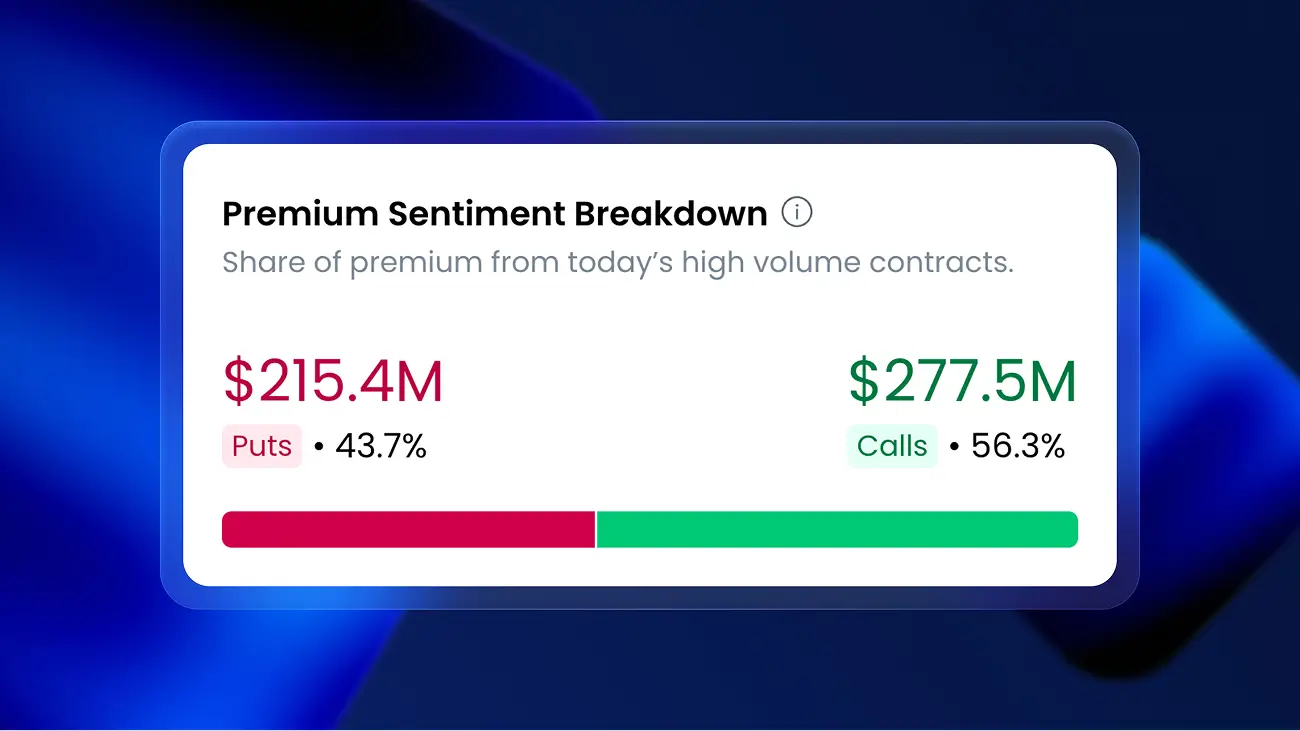
This is where elite traders live. Tape reading trading and unusual options activity alerts reveal market whales sweeping massive premiums — the kind of institutional flow that makes headlines later.
😉 “By the time the chart shows the breakout, the whale’s already on vacation.” — MarketSnack
Smart Money 101 — How Institutional Orders Create True Signals
Tape Reading: Prints at Bid/Ask, Sweeps, Bursts
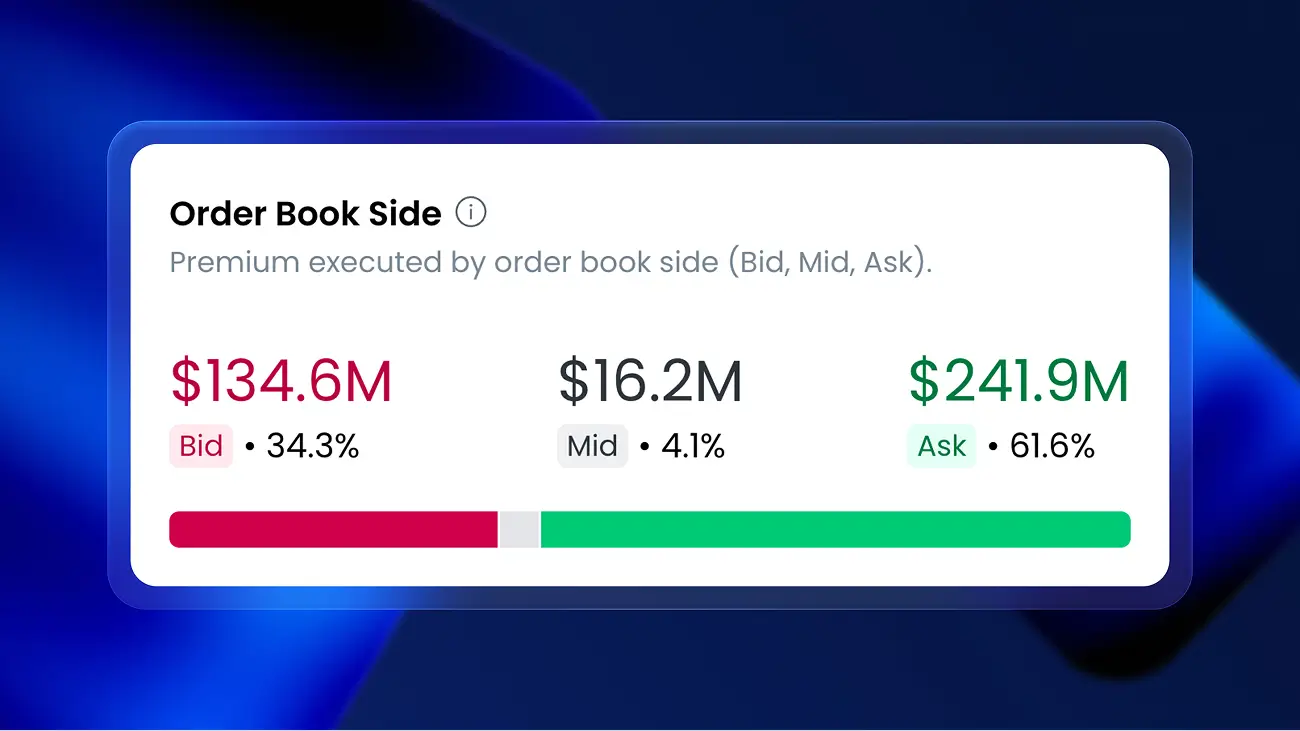
Tape reading is the lost art of reading raw market prints — trades hitting bid or ask, the speed, and repetition. It’s where true trading signals are born.
Market Makers & Liquidity Holes
Market makers control the spread — but when liquidity gaps appear, their hedging exposes institutional intent. That’s the pressure retail traders never see.
Unusual Options Activity (UOA) with Size, 0DTE, & Spreads
0DTE alerts and large spread structures scream institutional conviction. It’s not hype — it’s footprint.
Building Your Alert Stack (Beginner → Pro)
Core Stack for Intermediates: Price + % + RVOL + IV
This four-part stack covers 80% of useful stock alerts:
- Price alerts to track key levels
- % change for intraday speed
- RVOL for confirmation
- IV spikes for volatility
Advanced Add-ons: UOA, Big Spreads, Bursts
Once you master basics, layer in unusual options activity alerts, institutional sweeps, and burst detections for better context.
Multi-Layer Filters: Ticker, Size, Premium, Speed
Pro traders filter real-time stock alerts using tiered filters — ticker relevance, premium amount, and execution speed — to isolate smart money flow.
How to Set Effective Thresholds (and Avoid Alert Fatigue)
The Framework: Baseline → Context → Confirmation
- Baseline: define average volume or 1. IV for each ticker.
- Context: set multipliers (e.g., 2× RVOL, 1.5× IV).
- Confirm: require follow-up signals (burst + OI change).
Example: Breakout vs Mean-Reversion
- Breakout setup: alert triggers on volume + price surge.
- Mean-reversion: opposite — look for fading momentum after a spike.
Rate-Limiting & Bundles
Combine alerts into bundles — volume + IV + price — to avoid spam. Otherwise, you’ll drown in pings.
Noise vs Signal — A Simple Decision Tree
Size × Speed × Context
The holy trinity of signal detection. A 500K order in AAPL isn’t special — but the same size in a small-cap options chain? That’s a flare from the institutional traders.
Confirmation: OI/Vol, Delta, Clustering
Look for open interest confirmation or repeated flow in the same direction. When orders cluster, smart money’s building a position.
When to Ignore
Low-float hype tickers, fake pumps, or thin premarket moves — all classic traps for retail traders.
Case Studies (Step-by-Step)
Volume + Tape = Intraday Entry
A volume alert plus fast tape at ask shows market whales sweeping aggressively — early entry, tight stop.
UOA 0DTE + RVOL = Controlled Scalp
When 0DTE options light up with high RVOL, you’re watching institutions move fast money.
IV Spike + News = No Trade
When implied volatility jumps before news — skip it. That’s smart money hedging, not predicting.
Tools & Workflows — Broker, Apps, or Flow Platforms?
Broker Alerts vs Apps vs Flow Analytics
- Broker alerts: reliable but basic.
- Stock alert apps: flexible, but noisy.
- Flow platforms: contextual, real-time, institutional-level.
Latency, Data, and Feed Quality
If your “real-time stock alerts” lag more than two seconds, they’re not real-time. Execution speed is alpha.
FAQs (People Also Ask)
What stock alerts should I use as an intermediate trader?
Intermediate traders should combine price alerts, volume alerts, and implied volatility (IV) alerts — it’s the holy trinity of actionable signal.
- Price alerts tell you when momentum breaks levels that matter.
- Volume alerts confirm that the move isn’t just noise.
- IV alerts show you whether options traders — often institutional traders — are positioning for volatility
- ahead of the crowd.
If you’re serious about reading flow like a pro, layer in order-flow alerts or unusual options activity (UOA). That’s where the real insight lives.
Are real-time stock alerts truly instant?
Most stock alert apps call themselves “real-time” — but unless they’re plugged into a direct institutional-grade data feed, they’re delayed.
Even a two-second lag can mean you’re chasing instead of anticipating.
True real-time stock alerts come from platforms that aggregate tape reading data and order flow directly from exchanges.
That’s how you see what market whales are doing — before it becomes a trend.
What’s better: price or volume alerts?
Neither on their own — context is everything.
- Price alerts without volume = false breakouts.
- Volume alerts without price confirmation = directionless noise.
The best traders combine both, looking for synchronized moves — a price breakout with a surge in relative volume (RVOL).
That’s the formula institutional traders use to validate conviction and execution.
How do I get unusual options activity alerts?
Skip the generic trading signals bots and free retail apps — they mostly recycle public data.
To catch unusual options activity alerts, you need flow-tracking tools that scan for:
- Large premium size (institutional interest)
- Fast execution speed (urgent activity)
- Unusual OI/volume ratios (hidden buildup)
- 0DTE or multi-leg spreads (institutional strategy)
This kind of data reveals how institutional traders and market makers move capital in real time — the difference between reaction and foresight.
How do I avoid alert fatigue?
Alert fatigue kills focus faster than a losing trade.
The fix?
- Bundle your alerts. Combine price + volume + IV into a single trigger.
- Filter by impact. Only keep alerts tied to your watchlist • or strategy.
- Set thresholds. Don’t alert on every tick — require meaningful % or RVOL shifts.
- Limit frequency. Cap the number of active alerts per session.
The goal is signal, not chaos. The fewer pings you get, the sharper your reaction time.
Key Takeaways
5 Rules to Separate Signal from Noise
- Size and speed always trump hype.
- Volume confirms, IV explains.
- Institutions leave footprints — find them.
- Filters > frequency.
- No context = no conviction.
Your Minimum Viable Stack
- Price + % + RVOL + IV.
- Optional: UOA + tape flow.
Trade the Flow Behind the Alerts
Alerts Built on Real Institutional Flow (Not Just Price)
MarketSnack tracks trading signals stocks the same way institutional traders do — by following order flow, not headlines.
Filter by Size, Speed, Premium, and Structure (Spreads)
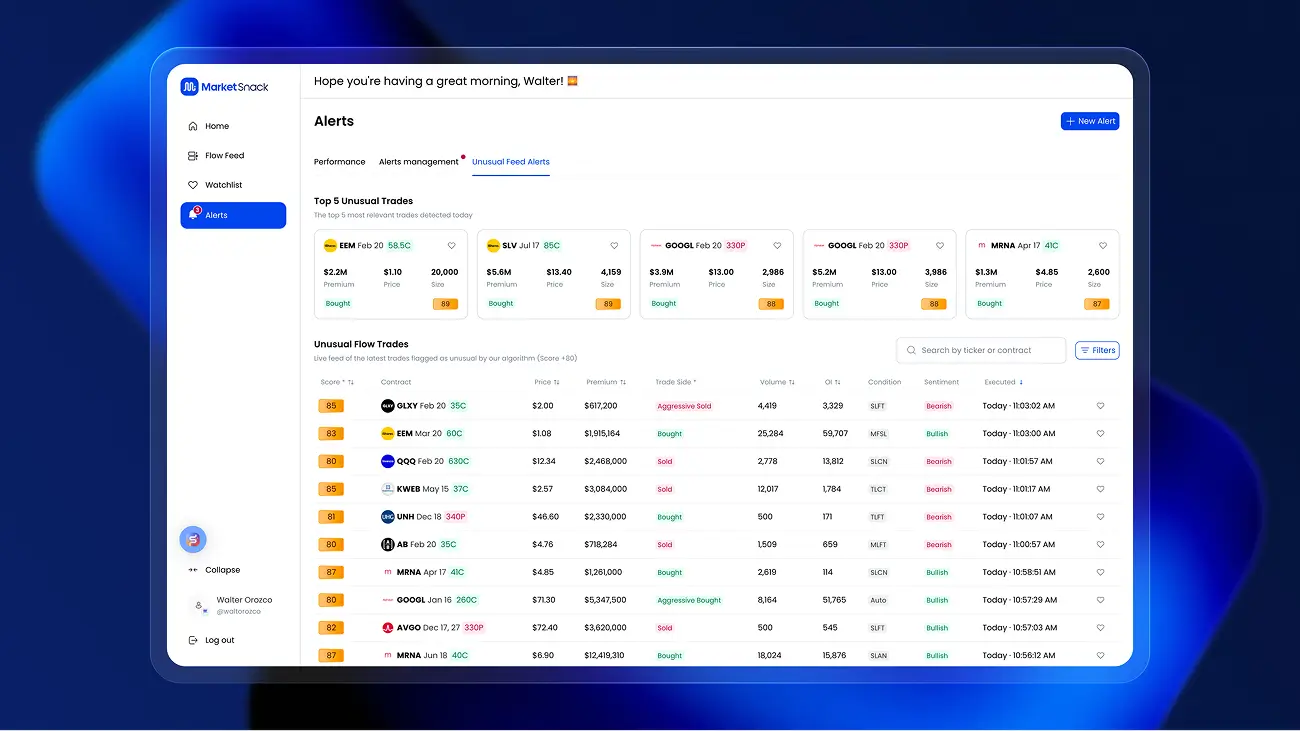
Each alert is ranked by relevance: premium amount, order velocity, and structure (single vs spread).
Actionable Context: Bid/Ask Pressure, IV, OI/Vol After the Hit
And here’s the MarketSnack edge: we don’t stop at the ping.
With Alert Tracking — Know What Happened After the Hit, you see every signal’s outcome — Success, Miss, or Still Elevated — based on real post-trade behavior.